 Skip to main content




ISO 80369-7 - what changed, and what to do about it
Published date: 29 Sep 2026
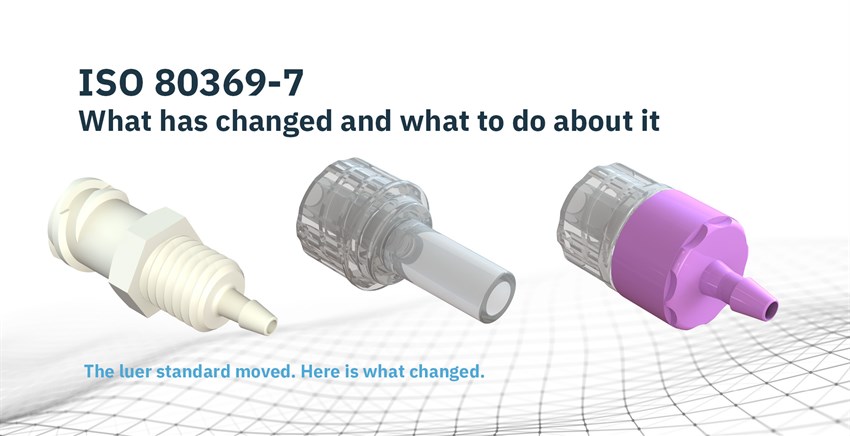
For decades, the luer connector was everywhere. If a medical device moved fluid, it almost certainly had one — the same small tapered fitting turning up in respiratory sets, feeding tubes, urinary drainage, blood pressure cuffs, spinal procedures and IV lines alike.
That universality was convenient right up until it was not. If every delivery system uses the same connector, any two of them can be joined — including two that should never meet.
The ISO 80369 series was written to end that, by giving each clinical application a connector geometry that physically cannot mate with the others. Luer connectors did not disappear in the process. They were reassigned to intravascular and hypodermic use, under ISO 80369-7.
And that standard has been updated since. The 2021 revision changed several requirements, including making the “t” dimension a reference dimension rather than a required one — a small change with real consequences for anyone specifying components.
What ISO 80369-7 changed
Under ISO 594, a plastic luer had to pass performance testing, and the standard acknowledged that for semi-rigid materials — which is most plastics — it was not practical to specify dimensions accurately. That is why so many component data sheets said a luer “mates with” the standard rather than conforming to it.
ISO 80369-7 requires materials, dimensional and performance requirements together, and adds a flexural modulus floor of 700 MPa that rules out softer materials entirely.
What the 2021 revision changed
The 2021 standard cancels and replaces the 2016 version. Four changes are worth knowing about.
- Tolerances were increased on several reference connector dimensions, to make manufacturing and certification easier. Most affected features do not contact the test connector and so do not affect test results. The angle tolerance for the bearing side of the threads does contact the connector under test, but the change is considered likely to have minimal to no effect on outcomes.
- Semi-rigid and rigid materials were separated. Some requirements for luer connectors are now specified by material type, to better ensure compatibility at the extremes of the design space. Definitions of semi-rigid and rigid material were added.
- The “t” dimension became auxiliary. The distance from the tip of the connector to the bottom of the first complete thread profile of the internal thread was made a reference dimension, because of the difficulty of measuring it. Its functional impact is now evaluated with the resistance-to-separation test under axial load.
- The N1 and N2 dimensions changed on the female luer lock connector variant A, the version with lugs at right angles to the axis, to allow measurement from the open end of the connector — again, to better ensure compatibility at the extremes of the design space.
The one worth understanding: the “t” dimension
The “t” dimension standardizes where the thread begins in relation to the end of the male luer.
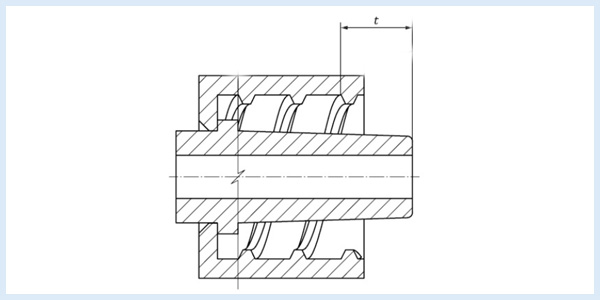
The “t” dimension on a male luer lock, half section. Schematic, not to scale.
It was a required dimension in the 2016 standard. In 2021 it became reference only.
This is a reasonable change, and it has a practical consequence: a supplier can now stop holding the t dimension and remain fully compliant with the standard.
It matters most during component selection. The t dimension was open to interpretation under ISO 594, and it is where fit problems between the male and female luer typically appeared. A program using a component from a supplier that adheres to the original t dimension will have less variation in the male-to-female luer connection. An OEM using a male luer from a manufacturer that claims the “reference t dimension” in the new standard will need to focus on the mating female luer and how well it seals and interacts, as the dimension is no longer controlled.
Injectech continues to hold the t dimension from the original standard, and third-party CT scanning confirms it. This allows our customers to remove uncertainty and variability when specifying components in their tube sets and manifolds.
What matters with what
The practical question for most programs is what happens when parts built to different standards meet. Here is the short version.
The middle row is where most programs sit today, and it is the reason the t dimension is worth asking about.
What this means by market
The conversion reaches further than it first appears. Any device with an intravascular or hypodermic fluid path is in scope.
- Cardiac and vascular — barb sizes from 1/16″ through 1/4″ cover most set and manifold designs.
- Drug delivery and infusion — the material requirement narrows the resin list where sterilization or drug contact is involved.
- Diagnostics and laboratory — panel mounts and bond-in ports where the fluid path meets an instrument enclosure.
- Ophthalmic — we have seen ophthalmic companies either switch to ISO 80369-7 or stay with ISO 594. Typically their regulatory departments make the decision on adherence to the new standard, as the surgeries are very specific.
What Injectech supplies
Injectech manufactures five product types to ISO 80369-7:
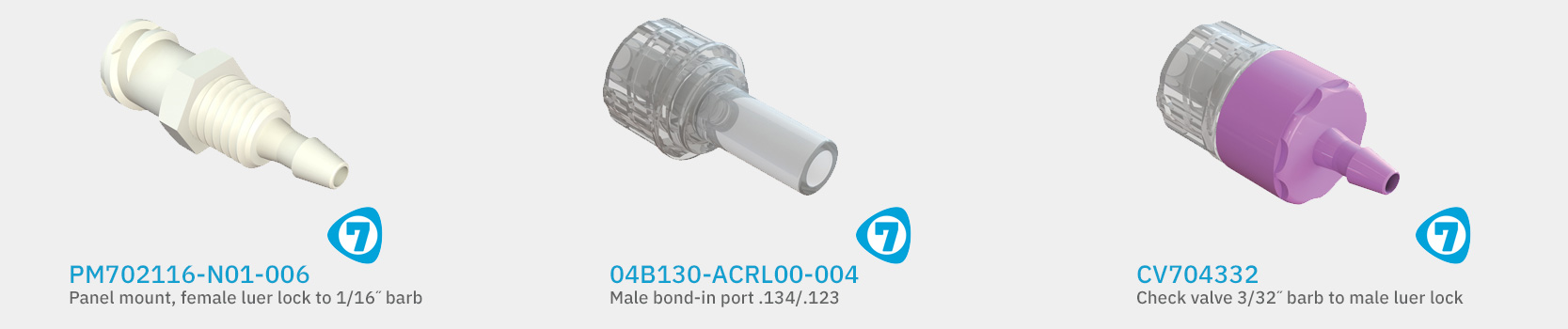
- Panel mounts — female luer lock to barb, 1/4-28 UNF thread, in 1/16″, 3/32″ and 1/8″ barb sizes
- Barbed luers — male and female luer lock to barb, from 1/16″ through 1/4″ tubing ID
- Bond-in luers — male ports in five sizes from .100/.090 through .310/.320 inches, and female ports from .065/.056 to .192/.183 inches
- Filters — in-line, with multiple barb sizes and luer configurations
- Check valves — female luer lock inlet or male luer lock outlet, across multiple barb sizes
Customization is available where a design needs an interface the catalog does not cover.
All parts are molded, assembled and packaged inside an ISO Class 8 cleanroom under an ISO 13485 certified quality management system. Luers are tested by accredited independent laboratories certified to ISO 17025.
A validation document covering the ISO 80369-7 products is available on request. Visit injectech.net to request samples.
Go Deeper
Our white paper covers the full history — why ISO 594 left compliance open to interpretation, what ISO 80369-7 requires, and how the "t" dimension changed.Read: The ISO 80369-7 luer standard, and how it affects plastic luer users → View White Paper
-
Read the white paper → /ISO-80369-7-Standards-White-Paper/
See ISO 80369-7 products → /ISO-80369-7-Products/
Request samples or the validation document → /Contact/

Leave us your comment
You need to login to submit a comment. Please click here to log in or register.